Monday, August 13, 2007

Tonga


Enroute, from Bora Bora to Tonga, we had several islands, in the Cooks, where we could stop and breakup the 1300 mile trip. Suvarov, Rarotonga, Palmerston, Rose, and Niue (I had my heart set on this one), were the main ones we had in mind. However, most don’t have secure anchorages in anything other than settled weather. Also, take into account Meri’s growing dislike of cruising and sitting in shitty anchorages whilst a low pressure system threatens to throw us on a reef, or beach, during 3 or 4 days of strong winds and large swells, and the fact that we don’t have insurance (long story), we opted to continue west while the weather was good.

The first 6 days we had ideal conditions, enjoyed great sailing (this restored her optimism), and averaged 120 miles a day in comfort. We were heading SSW towards Niue and some great diving. Niue has the clearest water, in these parts due to no runoff from the island. It’s filtered through a limestone layer instead. From there to Tonga is just over 200 miles, so it seemed like a good option. Unfortunately, another low was heading our way, and as we neared Niue, the wind swung to the NW, blew hard, and was predicted to veer SW, S, SE, and blow harder. We spent the next 21/2 days in 25knt+ winds and seas mounting by the hour. We were running with a double reefed mainsail and a storm jib the whole time. Luckily, the wave period was such that Adagio rode between them nicely. Friends on a 50 footer found themselves too long to fit and had a terrible time of it. Niue was, definitely, out of the question. Bummer. They don’t have a protected anchorage, but moorings outside the reef which are only protected in E and, light, SE winds. Rarotonga (before Niue) was also out due to the gales cruising past to the south.

Some may call us whimps, for running, but we don’t give a shit. At the end of the day you have to consider many factors, boat and crew safety, stress levels in shitty anchorages, your marriage/relationship, and are you really missing a whole lot. After 5 years on the boat, dozens of tropical islands, scuba diving, snorkeling, hiking, forests, tropical fruits, etc., etc., it all looks the same. We find more pleasure, now, in trying to meet locals and just hang out somewhere comfy. Call it tropics burnout, I don’t know. Looking forward to going skiing!!!! Bring on the snow.

At the moment we are on a mooring in Neiafu (The Va’vau group), Tonga. The people are very friendly, great produce and fish markets. Smiles all around from English speakers (such a relief after French Polynesia), and soooo much to do. We have planned an ATV trip around the island, a native feast and dancing, diving, and some hiking to nearby towns. The locals are quite religious and wear their traditional costume most of the time. We even found the reincarnation of the Dhali Lama comming home from church. Think it's him??? The singing in the church is quite beatufil and very pleasant to hear on a Sunday.

In total, we are looking at 3-4 weeks here before heading to Fiji. Hopefully the weather will cooperate soon and we can venture south to the Ha’aapai group of islands. These are even more laid back, and less populated, than the Va’vau group. Hope to enjoy an “umu” (local feast) or two whilst there. Along the waterfront there are several bars and yacht service type places that will do anything to attract clients.


"Tonga Bob's" has Trivia night on wednesday's and offers several prizes for each round. The grand prize is a case of beer. We won it twice in a row!!! I didn't realise how all that useless crap in my head would come in handy one day. Thanks for the beer and prizes Matt.


Thursday night they have the local "Ladies" come in to give a performance. Cross dressing is accepted in much of the Pacific and in Tonga they are revered as special entertainers. They put on a great, fun show and collect gratueties from the crowd. It's a sign of respect to place money on their persons. We had a great time but I couldn't help notice that one of the girls looked a lot like my old Greek school teacher!!!!!!


I finally managed to convince Meri to take a ride with me in an overgrown go-cart. We toured the island for 3 hours and had an absolute blast. It's so scenic and lush. The locals were all happy to see us and kids were trying to run after us in every town. It had rained hard the previous day so some of the trails were very slippery and muddy, cool. It's not something we'd do regularly, but once is worth it.


Thom, on SV Babel Fish, ask me to go for a sail out around the islands for a day and do some whale watching. What a great boat. It's a 50 foot Najaid from Sweden, worth $1,000,000 bucks and quite something to sail. Would most definitely love on of those next time round. Thanks Thom.


Morea & Bora Bora

Beautiful Morea was our next destination and only 4 hours away. We had heard, and read, so many nice things about this island and were keen to disprove the myth. We failed!

We anchored in, breathtaking, Cook’s Bay, along with S/V Opsray, and decided to set about exploring the lush valleys and mountains. We hiked through the lush countryside, picked some fruit along the way, to “Belvedere” lookout for a spectacular view of both, Opunohu and Cook, bays far below us. The first 5 or 6 kilometers weren’t too bad, or steep. Once we made it to the Opunohu experimental farms, and agricultural school, the walk became a climb through lovely forests and great views of the valleys below. We were almost out of steam when Chris, S/V Barefeet, drove past with his in-laws and promised to come back for us. He did and we were so grateful as our legs just didn’t want to cooperate further. The view was definitely worth the pain.

For the return trip we opted to stop at the farm store and have some home made ice cream, yummy, and then continue over to Opunohu bay and follow the coastal road to Cook bay. Big mistake. It was much further than anticipated, although the majority was on level ground, and we just couldn’t make it before dark. We decided to hitchhike and were finally picked up by a nice lady who was a bit of a historian as well. One interesting point she made was, 50 years ago the Moreans were, about, 90% independent of imports and lived an agrarian lifestyle. Housing was constructed from natural materials with walls woven from palms. Nowadays, they are 90% dependant on imports. It’s sad, but seems to be a common theme amongst the islands we’ve visited so far. I’m not saying these people shouldn’t modernize, it’s inevitable, just that it’s a shame they’re heading towards the same stressful, disjointed, selfish, lifestyles, we, the developed world, have adopted. I find it ironic that so many, westerners, seek simplicity whilst islanders are heading the opposite direction. If only they knew!

After the real hustle of Tahiti it was nice to be in a slightly more relaxing Morea. We just took regular walks and explored.

Upon leaving Morea we had a few islands to explore before Bora Bora, but decide to go straight to B&B to collect our security deposit and continue west. The decision was also influenced by the two large tears in our ancient headsail and a new, worrying, oil leak that developed at the front of our motor. After the squall which tore the sail we had a dead calm and sloppy seas, so we motored until I noticed the low oil pressure and shut down stinky (our engine). If it’s not one thing it’s another hey! Anyway, in Bora Bora we had time to address these problems – a huge thanks to Geoff and Meryl on Sifar for their help with the sail – and explore before heading west.

Meri fell in love with the Bora Bora Yacht club building and wants one just like it in OZ. She took numerous pictures and made sure I sussed out the building technique. It’s sooo us. Now we just need to find a bit of land at home and build it.

The scariest thing in B&B was the anchorage depths!! We dropped our hook in 22meters off the club and wondered how to retrieve 80 meters of chain with our little manual windlass and an uncooperative anchor locker. The first half of the chain has to be piled forward, behind a dam, before retrieving the rest. Not fun in any kind of wind with only the two of us. Lesson to cruisers, DEEP anchor well that can take all your chain easily, and, hate to say it, but a good electric windlass with manual option also. I was so tired after that episode. 22 meters of our chain, plus the anchor, weighs over 35 kilos. Dead weight hanging straight down!!

Well, goodbye to Polynesia and time for the Cook islands.

Sunday, July 15, 2007

Tahiti (Polynesia)

After a pretty lumpy sail to Tahiti we arrived at 1:30 am, in the lee of the island, and entered Papeete harbour with no dramas. I must hand it to the French in Polynesia, all the channels, passes, and harbours are well marked and lit. Every major harbour, or port, we’ve entered had range lights which you could follow even at night. We tied up to the quay for the night, did our official check-in in the morning, then proceeded down to the large anchorage past the airport. We didn’t expect the 100 or so boats scattered around the marina. Once again, a deep anchorage but, with a lot more boats than we are used to. Oh well, ce la vie as the French would say.


The nice thing is got to catch up with many boaters that we hadn’t got to know well in the past and also those we knew or hadn’t seen for a while. Our first night we went to see a group from the Austral islands performing in the “Haiva” festival. This was part of the inter-island dance competition that goes on for a couple of weeks. The festival brings islanders together from every corner of French Polynesia to compete in song and dance, display craft and art, compete in traditional sports and some new ones. It’s main purpose is to revive and promote traditional Polynesian culture, lifestyle, and pride. Between the whalers, traders, occupiers, and especially the missionaries, the Polynesians were almost wiped out . Only through the paintings and diaries of people such as Paul Gaugain (the painter), and Captain Cook, can we begin to understand how idealic their life used to be. Paradise lost seems to come to mind.


The dancing and singing that night transported us back in time – if just for a few hours it was worth it – to a place and peoples who just enjoyed life in a land of plenty. We were absolutely mesmerized by the colourful costumes, the tribal beats, and truly beautiful people. Our photographs jus don’t do them any justice but, it’s all we have to share with you. Two nights later we went to see another troupe with a modern take on a traditional theme. The most spectacular dancer was the transvestite, in the hot red outfit, who did an incredibly sexy solo number. Transvestites are common and completely accepted in Polynesia. Just like the Kunas, in the San Blas, some families will raise a son as a daughter should they have only boys. We have seen quite a few so far.


Apart from the dancing we cruised the artisans stalls where the best craftwork in the nation was on display. In the past, all craft had to made with 100% local products or it wasn’t admitted into the craft show. Nowadays some imported materials are allowed, in combination, whether this is a good idea I’m not sure. The main categories were, carving (bones, shells, wood, stone), jewelry (black pearls, mother of pearl, shells), weaving (bags, hats, mats, chests, screens, and even walls for huts), and patchwork quilts. It’s amazing what these people can make from local materials. Unfortunately many items are out of our price range, e.g. A $3000 necklace at a craft fair!! We wanted to buy many things but, had to restrain ourselves to more affordable items.

The sports competitions were also a big crowd draw and we watched several outrigger canoe races and a local mini Olympics. Sports included running with fruit on each end of a pole slung on your shoulder, spear throwing, rock lifting, etc. June/July is a good time to be in Tahiti for sure.

The Gaugain museum and attached botanical gardens are also worth a visit. Gaugain was upset at the changes occurring throughout Polynesia and decided to record as much of the local culture as possible. He did it quite eloquently and preserved a peoples for time immemorial. The gardens were an absolute joy to wander through, in the heat of the day , and enjoy the coolness of many species of tropical trees and flowering shrubs. Would make a hell of a backyard.

We’ve had a great time here and would recommend it to all. Just be sure to bring lots of money as Polynesia is definitely not cheap. Prices here are on par with Europe.

Saturday, July 14, 2007

Rangirora (Tuamotus, Polynesia)


Our arrival at Rangiroa was, thankfully, uneventfull and well timed to coincide with slack high water. We motored in with no counter current nor large seas at the entrance mouth. On approach it was a, surprisingly, well vegetated and luxuriant lagoon fringe. I say surprising because we expected some low, sandy, coral atolls, with nary a cocoanut tree. Quite the contrary!

Upon entering the channel we were approached by a 2 meter shark, probably looking for a handout – they dive clubs used to feed them so tourists in the glass bottom boats could take pics- of fish, who cruised around us for a while before losing interest. We motored past the, “Motu” , small island inside the lagoon and around to the anchorage to anchor in 13 meters of water. Oh for an electric windlass and a deep anchor well. The next 3 days we spent walking around the towns, meeting up with friends and just relaxing.

Ospray came in after a couple of days and we decided to do a few dives with the “Six Passengers” dive outfit near the hotel. They gave us a very good rate thanks to Katie on S/V Asylum who did the negotiating. $20 less than the hotel’s dive shop!

Our first dive, just outside “Tiputa” pass was spectacular to say the least. We saw an abundance of, very tame, sea life of all shapes, sizes, and colours. I was particularly impressed with the sea turtles and grouper completely oblivious to my proximity of less than 1 meter. If I had a spear gun in my hands the grouper would not be so curious, however, they were almost close enough to touch! The next two dives were in the other pass, “Avatoru” with some mature “white and gray tipped” reef sharks and a large school of “Horse-eyed Jacks” that swam in a tight ball right above us. They dive leader took a piece of fish and tucked it under a rock on the sea floor. We were hovering just meters away as these sharks tried to pry the fish out from under the rock. Wisely, the fish had been bled elsewhere to avoid over exciting the sharks. They weren’t frenzied in their attempts but, rather playfully wary as they swam around us and back to the fish. Several times they approached us within lees than meter. I had one so close that counting his teeth wasn’t hard. Yet they didn’t pose any threat at all. Would some blood in te water have changed that I wonder? Glad we didn’t find out. After that we swam along the reef towards the pass where the Jacks were gathered.

One instructor had kept a piece of fish with him in a bag as we swam along. One shark followed him and casually attempted to take it from him. The instructor would just push it away casually as if it were a dog. As we approached the Jacks several spotted the shark, broke from the pack, proceeded to flank the shark and bang into it thus driving itaway from the school. The instructor had wanted to demonstrate this by luring old sharkie close by. The rest of the dive I spent checking out the cool coral, fishes, and swimming under the school of Jacks so I could look up into the whirlpool they created at their center!! What a great dive. So great that we repeated it the following day.

Yanni, from Ospray, and I also had a great snorkeling experience inside the pass. We were on the channel side of the Motu just as the tide was coming in. Normally you can go out to the mouth and drift in, but we heard it wasn’t that interesting as it was had to remain stationary. We found some iron rods protruding from the motu and held on as the current increased. This turned out to be a great idea as we watched sharks cruising along the channel to our right in search of food. Before long we found ourselves surrounded by schools of various fishes waiting for incoming snacks also. They completely ignored us and we had an excellent opportunity to observe them at close range. Some of the sharks did come an observe us closely as well, much to our discomfort. They weren’t mature ones so I doubted I’d lose more than a foot or hand. Small price to pay for all the fish I’ve hunted!!! Nothing happened and it was the best snorkel I’ve had in years.

We also visited a local pearl farm and were given the 20 cent tour. Basically they whisk you through the process so yu have more time to buy pearls. Ha, not at those prices. Still, it's interesting that it takes five years to produce a saleable pearl from scratch. Cultured pearls are grown around a foreign object introduced into the oyster (a plastic ball in this case) which then grows around the object to protect itself. Interesting huh!!

Whilst planning to leave for Tahiti a nasty low pressure system headed our way and produced some very nasty seas in the anchorage. The wind clocked to the west then gradually the south and blew for 3 days. This created quite a sea as we were only protected from the east and north. Our chain wrapped around a coral head, thus shortening our scope, the higher swells broke our nylon snubber (chain shock dampener), the chain flew across the deck into my leg as I replaced the snubber, I bled everywhere, Meri freaked out, I hated sailing, we both wished for dry land, garden, house, dog, permanent friends, etc. All within a few hours of the wind changing. Too long on the boat???? Probably. However, we soon got over it but realized we needed to get off adagio and got out to some cultural events somewhere. Two days later we sailed to Tahiti for to “Haiva” festival and some fun ashore.

Friday, July 13, 2007

Marquesas (Polynesia)

Fatu Hiva, the southern Marquesas, was our first port of call after the 26 day crossing. I don’t posses the vocabulary to describe the relief at sighting land. It’s not that the sail was particularly trying, just the longest we had ever undertaken and our stores of fresh produce were exhausted except for onions and potatoes. The Adagios were craving fresh fruit and salad greens!!!

The anchorage in the valley is quite spectacular and very lush. The mountains rise up from the sea bed to the north and south with the valley floor at the head of the bay. Several pinnacles rise up from the valley and one even resembles the face of George Washington. A Polynesian Mount Rushmore?? These pinnacles have a quite phallic appearance hence the original name “Bay Des Verges” (Bay of the Phalli) given by the early explorers. Supposedly the missionaries disapproved and inserted an “i” making it “Bay Des Vierges” which translates to Bay of Virgins! An interesting bit of trivia. Who knew the difference between a phallus and a virgin was an i!!!!!!

Upon arrival Geoff and Meryl on S/V Sifar graciously invited us over for dinner and drink. They had arrived two days prior and knew we wouldn’t be in any state to cook. Thanks for the curry guys.

Next day a bunch of us took off hiking to the famous 200’ waterfalls for a nice swim. We were worried about the 45 minute hike as our leg muscles had atrophied during the trip – our legs felt so weakened and soft – and didn’t know if we were up to it. Well, we got lost and it turned into a 4 hour hike instead. Got to see plenty of the valley and mountains around the anchorage before stumbling onto the falls. It was all worth it when you felt the massaging water on your body. Also we had our first looooooong shower in over 3 weeks. Yummy.

The next task was to procure fresh produce from the town. Meri headed into town armed with a Spanish-French phrase book, some cheap smokes and makeup kits for trading. She arrived back at Adagio with fruit, eggs, bread, and local money! A lady wanted a small makeup kit we had but was out of trading goods so she just offered cash. Hey who can resist. The pampellmousse (grapefruit) she got were absolutely huge and delicious. They taste like a cross between an orange and a regular grapefruit. Half of one is a meal in itself and they grow everywhere on the islands. Over the week we did some boat repairs, checked out the town some more, and got to know cruisers, in person, that we had only heard on the SSB radio during the trip.

Now, Fatu Hiva is the last island, in the Marquesas, to produce Tapa cloth (produced from the inner bark of trees) of superior quality which is stenciled or tattoed. In our anchorage the better ones had already gone to the “Haiva” festival in Tahiti so we decided to visit Bay Omoa to the south and check it out. To get there we had either a 4 hour hike or a 30 minute dinghy ride. Which would you choose??? Taking Adagio was out of the question as the anchorage is VERY rolly with poor holding. We dinghied there with Chris and Erin from S/V Barefeet and the Sifars. The landing dock was quite scary and had to be negotiated carefully in the large swells. We decided to leave one person minding the dinghies in the bay and rotate the chore.

Meri found the right tapa place and bought 3 beauties from the old lady there. I really wanted the 3 meter long tapa she had on display even though it was a little pricey. However, storing large, delicate items on the boat isn’t easy. Especially when they can be easily damaged by water.

Both the towns visited were spotless, lush green, fruit growing everywhere, and the people some of the friendliest and mos t courteous we have met. Great start to our Pacific tour hey.

After fixing our battery charger, alternator, main sail, and engine oil leak – we had to use parts onboard or improvise as the towns had nothing of this nature to offer- with a little help and advise from friends (thanks George S/V Thalia and Ray S/V Horizon, the big guy in the canal transit photo’s) we decided to head off north to the island of Tahuata.

Unfortunately we ripped the mainsail again (different spot) in a huge gust and coul only limp along under staysail alone. The weather had deteriorated and strengthened so the genoa wasn’t a viable option. The anchorages in Tahuata , as in most of the Marquesas, are exposed to the sea so we kept going to Nuku Hiva and it’s more sheltered bay. Also we needed to check in officially before they fined or kicked us out.

The trip was very uncomfortable in large seas, up to 4 meters, and strong winds but, Adagio excelled and we arrived safely. The following day we had to post $AUD2600 as a security bond to obtain a 90 day visa and cruising permit for French Polynesia. What a rip off. Of course we get the money back but, in local currency on the other side of Polynesia. The conversion both ways, kills you and can cost as much as $300 after bank charges etc. At least the Bahamas just hit you up front for the $300.

Nuku Hiva was also very beautiful and we watched the local outrigger canoe racing one weekend. Unfortunately we missed the mother’s day festival with dancing and a huge feast. Will make up for it in Tahiti, for sure, during the “Haiva” festival. During our time here the weather alternated between nasty and dead calm for a day then back to blustery. We wanted to visit the island of Ua Pou to the south, on the way to the Tuamotus, which has some cool carvings and loads of cheap fruit. However, friends anchored there radioed that the swells were rolling in and made it very uncomfortable at the time. We had a nice 4 day weather window that shouldn’t be wasted so it was off to the Tuamotos for us. It would be nice to see everything but, not possible with limited time and another 4000 miles to sail homeward.

The sail to Rangirora was exceptional and fast (580 miles in 90 hours) with no damage and a happy crew. We didn’t actually choose our destination as there were dozens of islands in our path. Rather, the wind shifting to the south chose it for us and we maintained a broad reach just shy of blanketing the genoa. It didn’t matter which island we arrived at as they are al unique with very dangerous passes to negotiate into the lagoons. They are, basically, volcanic craters that have eroded to just above sea level ad have one or two passes to enter from. The currents can be fierce, the swells running across the passes, and the current wind driven waves, in the passes, very high and steep. Sounds lovely!!! We planned well, arrived at high slack water, and motored in on a flat calm sea. Not so on other atolls. Two boats had run aground and been lost during our stay. The western pass to Rangirora had two sailboats washed up on it’s leeward shore!!!

Anyway, we set the hook, slept all day, and prepared for some cool diving.

Wednesday, June 13, 2007

Galapagos to Marquesas (French Polynesia)


Hey everyone!!!!!!!!! Yayyyyyyy we’ve made it. Longest trip of our lives and hopefully the only one. Sorry it took so long to write but this has been our first opportunity , we don’t have email onboard. We left the Galapagos on the 30th April and arrived at our first destination on the 26th May.

We managed to sail from Santa Cristobal until that evening then the wind died completely and we found ourselves being pushed towards Santa Maria by the current. Not being die-hards, nor having a rowboat full of crew, we turned on the motor and headed south until morning. This got us into a mild breeze that stayed with us for the next ten days. We were told by friends (they had done the trip previously) and weather experts to sail down to around 7 degrees south in order to find the constant SE trades. 15-20 knots for the next week or so and by the 10th day had covered 1500 miles. Another 1200 miles or so to go and 10 more days and we would be there. The waves were not as smooth as we were led to believe, they were pretty lumpy and it was necessary to double reef the main to slow down, surfing waves at 11 knots was a little too much. Still we were happy to make good time. Then a tropical system had developed about 1000 miles south of us near Pitcairn island and sucked all our air away. The winds got lighter and lighter until we had a couple of days of nada. Of course we still had the swells which was a good thing since it was the only thing that was pushing us along. Turn the engine on, no other choice, that or have our sails flog themselves to death. 10 days just became 20 and it didn’t seem likely we would get any more wind for a week or so.

We didn’t have any major mishaps along the way, it was more boring than anything, there’s only so many books you can read, the rest of the time being taken up by sleep and eating, as much junk food as possible, comfort food. Everyday we would tune in to the radio net and keep in contact with friends doing the journey as well. Our friends on Pagos were headed down to Easter island and lost their forestay and lucky didn’t lose their mast. Another friend, George, on Thalia actually fell overboard. He’d been sailing for 15 years and this is the first time it had happened to him. There was no wind and they were basically floating along. He went to take down the Spinnaker that had not a breath of air to fill it, wrapped his hand around it and from nowhere came a gust of wind and lifted him and the spinnaker and put them both into the water. Now he’s in the pacific ocean alongside the boat and screaming to Isabella, his wife, to help and she knows less about sailing than I do and couldn’t help. A swell swept him to the boat and he was able to climb aboard. George said that Isabella immediately learnt how to use the SSB radio afterwards in case it happened again and she could be rescued. Hey a girl has to have priorities.

Dimitri did a lot of fishing – whenever the numerous sail changes and course corrections allowed him a spare moment- and after a week of nothing caught with the hand lures decided to use the fishing rod and immediately caught a 60 lb tuna. Took him an hour to get it aboard and there was enough meat for 20 meals. In Panama I had bought lots of nori, wasabi and soy sauce and we ate sushi for days, excellent. Next he hooked a 2 meter long Marlin and managed to get it alongside the boat. After a struggle the fish decided it wasn’t ready to join us in the cockpit and broke the leader wire. Probably a good thing as our freezer just didn’t have the room!! Then he caught a two smaller tuna and, my favourite, a mahi mahi and I was in heaven, it has to be the best tasting fish in the world.

So now it’s 22 days on the ocean and we’re both pretty much had enough and with a few hundred miles to go. It’s the most difficult time because you are so close and you just want to see land again, you start to believe you’ll never see it again. The last day we had only 85 miles to go and now we have to slow down otherwise we’ll arrive in the dark which I hate to do and that makes you crazy. Finally we arrived at Fatu Hiva. It’s the most south eastern island of French Polynesia and the only island where Tapas, ink tattoo painting on bark are still done. It’s not a point of entry so we had to be careful to avoid officials. Totally gorgeous!! Just like the movies, large volcanic island covered with lush vegetation. So happy could have wet myself. The first thing we did ashore was to look for the waterfall we’d heard about. Off we trekked, with a few others, and proceeded to get lost in the mountains. Nobody seemed to care, we were just happy to be using our legs again after so long at sea. Finally we found it, a 70 meter waterfall with a swimming pool at the base. Oh what joy! We swam, bathed, showered after a nice picnic lunch on the rocks. The next day my legs felt like I’d been training for the Olympics or something. I could barely move my muscles so I decided to flop over the side and go for a swim in the deliciously tempered water.

We stayed a week and then sailed overnight to Nuku Hiva for our official entry procedures. The 24 hour trip was more exhausting than the trip across the pacific and we ripped our mainsail in the 35 knot gusts at the start of the trip. The remainder was sailed on, firstly, staysail, and later, genoa alone. Not the most stable of conditions at sea but we had no choice. We checked in and paid the outrageous deposit for non European citizens, $AUD2700 dollars and are now relaxing, in between sail, battery charger, and alternator repairs, for a couple of days before moving on to the next anchorage west. It has a, clean, fresh water supply, an even taller waterfall, and an isolated anchorage. That’s the place to relax!!. In the next week or so we need to get going to Tahiti to do the official check in. We hope to stop in the northern Tuamoto islands and do some snorkeling for a few days. They have black oyster farms there that we’d love to check out.

Well that’s about it for now. Will try to post some photo’s on our blogspot for yall. Love and best wishes to everyone from us both. Cheers.

Sunday, April 29, 2007

Panama to Galapagos

Imagine long gentle, turquoise swells with just a faint ripple glittering on the surface like millions of diamonds. A gentle 10-12 knot breeze from the SSW and Adagio is heeled at 8 degrees gliding along at 5-6 knots. The breeze is so cool that you have to sit in the sun to warm up. Not a single vessel or island in sight to remind you of the world we try hard to forget at times. This is without a doubt the most perfect sail I’ve had since departing Sarasota. Even more so knowing it may continue for the next 750 miles. Not.

Well, that´s how we started our first day of the Panama to Galapagos trip. Monday 9th April we left Panama at 9:30am on an outgoing tide and decided to sail to the available wind rather than everyone’s advice. Upon exiting the shipping channel we had a 15 knot WNW breeze and decided to make as much southing as possible and keep Las Perlas to port. We reached south at up to 8 knots in a long swell capped by a 1 meter sea. During the day the breeze remained fairly constant but backed to the NNE and we found ourselves running dead down wind with sails poled or prevented wing on wing. Apart from the odd maneuver to avoid the numerous ships we sailed between 190 degrees and 210 degrees throughout the night. We sailed under a half moon at 5-6 knots and the water was so calm that we didn’t get the usual gut wrenching rolling that modern, short keel/fin yachts are famous for. The most incredible thing, however, was the luminosity of the phosphorescent plankton. I’d heard how much more prolific they are in this region but had no experience of it. The tail behind Adagio was least a boat length and the bow wake had the appearance of that bright green moss you see in forest photos.

Sometime in the wee hours, trying desperately to stay awake, I had a hell of a fright. Staring at the hypnotic sea, over our starboard beam, I noticed several long, phosphorescent projectiles rocketing towards our hull! I stared in wonder as they submerged and surfaced on the other side. Somehow we had miraculously survived a torpedo attack. This is what comes from sleep deprivation, an active imagination and a love of naval history. I was seriously looking at the water for the periscope. Then I heard the dolphin’s blow air through their blow holes and saw them returning for another go. Time for a coffee! They proceeded to amaze me for an hour before departing. I’ll never forget their glowing outlines as they raced past the boat to leap the bow wake and return for another run. I desperately wanted to wake Meri but she had just gotten to sleep after some initial insomnia and I didn’t have the heart to spoil it.

Tuesday 10th Around 8:00 am I was feeling a little dejected. What little breeze we had was on the nose. To conserve fuel and have some silence we put out the chute and close reached SW at 2.5 knots until 8:30 when the breeze pinched up and shifted to SSW allowing us to put out the genoa and enjoy our picture perfect close hauled sail.

18:30 The breeze has now officially quit. Nada. Niente. We are drifting at 0.5 knots on the current and rolling a bit on the swells. Time to turn on Stinky and run at high idle to conserve fuel. Not to worry, had my perfect sail and am still grinning ear to ear. Plenty more to come south of the equator I’m sure.

00:00 Apart from the long swells the sea is so calm that it’s taken on a mirror sheen and is reflecting the stars. Not sure what they are but we are passing some sea life that lights up like a 60w bulb under the surface near the boat. Cool. No visitors tonight except for a school of fish blazing green trails around us and a shark looking for something to eat.

Wednesday 11th 0400 The breeze has returned, 5-8 knots from the south so we hoisted the chute and are making about 4 knots. Add some cool blues to the mix and I’m loving it. Meri shook her head at my dancing and returned to bed.

0800 Shit, no wind again. Oh well, old stinky again.

0930 Mild breeze from the south, sailing at 3-4 knots, 240 degrees with some peace and quiet again. Time for breakfast, yummy!

Basically we spent the day trying to sail SW but the wind kept swinging from S-SW at different velocities all day. We have also sailed into a current convergence zone that reminds me of the Bahamas. The surface appears to be boiling and the chop is coming from all directions making headway is very difficult. Wind light so have to fall off to power through the chop that has developed. Either we sail 150-165 degree or 260-275 degrees at 1.8 knots and getting pushed sideways. Either way we don’t get much closer to Galapagos. Charts and routing planner show westerly current, what we hoped for, rather than an ESE set. Maybe the El Niño effect.

0400 heavy rain squall.

Thursday 12th. All day pretty much the same as the 11th except only one current to deal with now. The ESE bugger. With a SW wind and an ESE setting current any westing is very, very slow and uncomfortable. Can’t pinch too much because breeze is light and the chop knocks the bow around and we heave to. South east it is. At least we have good speed. However, we are losing our windward advantage. Hopefully we’ll get it back further south when we meet the west setting current. But where!

Friday 13th 0900 Have tacked back and trying to make westing again. Slow going at 5 knots but any more sailing SE and we end up on the Ecuadorian mainland. After WSW all day to stay off the SE mainland we managed to make on 32 miles to windward and barely held our position south. The breeze has died and we are being pushed SE at 2 knots. Time for stinky. Obviously some are more dedicated than us and would ride it out. Sorry but the rolling is shit.

Saturday 14th. Motored all night into the swells and current but can’t run at full speed because we consume too much fuel. Still 480 miles to go. Sailed from 0900 to 1630 but were again forced to the east. Have reached 01.43 degrees north and are hoping the current will swing to the west along the equator soon.

600 Yaaaay. The current has quit and the breeze has picked up a little. It has also come around to the south and we are now sailing at 265 degrees 5 knots for the Galapagos. Finally!

Sunday 15th. 0730 01.35 degrees north 81.48 degrees west. Breeze SSW 8-10 knots course 267 degrees and 4.8 average speed. Managed to sail all night and avoid a couple of squalls. Wind stayed constant at no more than 15 knots and we loved it.

1430 Breeze still holding and have tried to head down a little more 260 degrees to meet the equator. However, the light breeze won’t allow ‘flat’ Adagio to sail too tight without losing headway. 15-20 knots of breeze would be ideal but beggars can’t be choosers. We are loving life and even had a beer with lunch to celebrate the beautiful day and conditions.

1430 Same conditions

1900 Same

Monday 16th 0300 The wind has officially quit again and will once again motor or float. We chose motoring and charging the batteries.

0430 Same

0830 Same but beautiful day 00.27 degrees north 83.21 degrees west

1100 Yaaay We’ve got 8 knots of breeze, put up the genaker and are making 3-5 knots, 252 degrees true. Managed to have a beautiful, lazy sail all day and nod off in the cockpit under a nice clear sky. It’s one of the most surreal sails we’ve ever had. The sea has barely a ripple on it but we are ghosting along at a lazy, quiet 3 knots.

Tuesday 17th 1900 Sailed all night, parallel to the equator, don’t want to cross at night and miss the party, at 4-5 knots and FROZE our arses off. The temperature is 70 degrees F but the wind chill is bloody freezing. We have to wear pants, socks, fleece top and heavy jacket just to stay warm. It’s strange but, since leaving Florida, this is the coldest we’ve ever been and we are on the equator! Now sailing at 6-6.5 knots, 250 degrees true under beautiful clear blue skies. Just loving it. Didn’t expect a south wind at 10-15 knots on the equator but who expected to freeze either. Only 265 nm to go but we are still undecided as to which anchorage to check into. If you move they charge you port fees again. Cheeky bugger.

1600 Still sailing port hull up an averaging 6.2 knots with a max speed of 6.2 knots sometimes 7. Just having a ball. Wind is from the south at 15-18 knots and staying just below the need to reef. Usually we reef earlier but with the boat so loaded with provisions she rides stiffer. It’s like having 8 guys on the rail.

Wednesday 18th 00.00.00 degrees north 85.04 degrees west. Breeze from the south sailing at 6 knots, clear skies, 1 meter swell, 250 degrees true.. The equator at last!! Had our little celebration drink and toast to Neptune. Only 270 nm to San Cristobal. Nearly there, hope the wind holds. The rest of the day we spent alternating between slow sailing and motoring. We could just drift but we aren’t much in favour of just hanging around when land is so close and we have plenty of fuel left.

Thursday 19th 0000 hours. 00.55 degrees south 88.42 degrees west. Seas dead flat, not wind, motoring at 5.5 knots, 38 miles to San Cristobal. With no moon out it’s quite amazing to see the stars reflected on the sea as if it was a black mirror. Quite mesmerizing to say the least. Unfortunately, the darkness also made it very difficult to distinguish between the sea and horizon. Many stars rising were mistaken for ships and kept us on a false alert watch system.

0400 Light fog has set in but the air temp is not too low, 75 degrees. All conditions still as above.

0600 Heavy fog has reduced visibility to about 50 meters. We don’t have radar and were quite nervous being only 8 miles from land and worrying about fishing boats and small freighters.

0800 Have rounded the SW point of San Cristobal and are heading NNW, towards the shoals, outside Bahia Naufragio, and a certain grounding. Just kidding. Doing 2.5 knots and plotting our position every 15 minutes. The paper and digital charts correspond so that’s good. Just got a call from SV Thalia and George asked if it was us that came barreling past them in the fog 100 meters off his port beam. Not us, we were still 2 miles from them but we were worried nonetheless. 0830 The fog has thinned enough to make out the reef breakers. We are taking a shortcut between the shoals outside the bay. Looks like great surf. No wonder we saw so many surf shops in town later.

0900 Fog has lifted and we are right in the middle of the channel and looking good. Anchor down and we let out a huge sigh of relief. We have sailed 1180 miles, our longest trip yet without killing each other or wrecking the boat. Just had our first visitor; a sea lion who’s come over to say hello. What a cool little guy.

Panama Canal Transit


Cartagena to Panama via the San Blas Islands


The first stop was at the Rosarios, pretty islands with very few people but lovely water and an abundance of seafood. We entered a nice lagoon on the north side of the largest island for protection from the sudden southerlies. What a lovely spot, so tranquil. Dimitri thought about snorkeling for crabs and lobsters but the fishermen came around everyday and sold us anything we wanted and for a few dollars. They even cooked it up for us. All we did for a week was relax, tour the island in our dinghy and read. A few local artisans would cruise by occasionally and offer, very pretty, bracelets, necklaces etc. We didn’t see anybody for a long time but it wasn’t lonely.

The waters around the Rosarios were much clearer than near the mainland so we enjoyed some snorkeling and lots of swimming. Such a welcome relief after the noise and dust of Cartagena. We cruised around a lot with our dinghy and visited an outdoor aquarium on a nearby island. Most of the exhibits were no more than a fenced in area off the south side of the island. Very cool. No infrastructure, other than some fencing, to be concerned with. They had a variety of local fishes and we saw our first swordfish up close. The turtle breeding program was quite interesting and their, new, teaching/training facility was up and running. Nice day out.

After the Rosarios we decided to check out San Bernado, to the south. After a nice day sail we dropped anchor on the south east side – actually this was really the only viabe anchorage – in a sand patch amongst coral. I wasn’t too happy with the exposure to the SE but the only alternative was to continue through the extensive shoals with nighfall approaching. I don’t think so. Of course, that night the wind swung to the SE, blew hard, and sent in a 2 meter choppy swell. With a lee shore looming ominously behind us a second anchor was required. Meri helmed beautifully in the tall, sharp, swells so I could drop the big Bruce anchor in another sand patch 15 meters to port. Once I was satisfied they were both set there was nothing more to do than ride it out. I spent all night in the cockpit waiting for the drag alarm to go off. In the wee hours the wind was gusting over 30 knots and Adagio was jerking on the anchor rodes like a pissed off brumby. We decided to turn on the engine and keep it in forward gear until the wind let up. Well, paradise or not, in the morning conditions had abated slightly so we weighed anchors and buggered off..

Once we exited the shoals we had two choices, sail westward, to Subzuro on the Colombia/Panama border, and deal with the mounting seas, or, 12 miles east and anchor behind a river delta to wait for normal conditions to return. We decided to hide and wait. See we are learning. After a nasty 4 hour beat we anchored in a lovely bay, north of a small river mouth, and watched the local fishermen casting their nets. Two days later the wind was from the north again, seas had abated, and we headed off. The sail was lovely but we covered too much ground and had to slow down and wait for sunrise before entering the bay. As we were entering no town was visible yet, we had been assured there was one and basic provisions were available. Just as we prepared to drop anchor off a beautiful beach we noticed the town to our right. The bay was an L shape with the town nestled in behind the mountains and out of the swells. What a lovely place. Another boat suggested we put out a stern line to the beach and keep the bow pointing out of the bay and into the swells. This worked fine and we had no rolling.

The locals could not have been more welcoming, I guess they are happy to have folks dropping in for a visit. Subzuro is not accessible by road but is a significant border town and has a large military presence. We were required to visit the commadante and report in. He just inspected our passports, made an entry in his log book and asked how long we wanted to stay. We asked what was acceptable and he said up to two weeks was ok. Not bad considering our Colombian visa had expired and we had cleared out also. He was very nice and suggested we take ‘Via de Miel” the honey path to the mountain top where they have observation posts and watch the Panamanians on the next ridge. Great views abounded, however, we forgot our camera and don’t have any photos. Along the trail we saw a couple of beautiful houses with huge porches that were surrounded by tropical gardens. Apparently many artists have retired to this little town for inspiration. I could easily do the same. It’s one of the few places we’ve been to that just seemed ideal. Walking from the town, along the waterfront, around the bay was possible and we got to view several, cute, retirement homes.

Our next stop was in Escoses, the eastern San Blas islands (the land of the little Kuna Indians), at the site of an old Scottish settlement. I don’t remember the exact details but, a group of Scotts found this place ideal for a settlement, built a small fort, and began to farm. They fought off several foreign raiding parties over the years but disease and isolation forced them to return to their homeland. Many years later another group had the bright idea of returning and trying again. However, the Spaniards had occupied the place since and didn’t want to give it up. There is a very small Kuna village there on the ruins but we weren’t allowed to visit as it was a ceremonial period. On the shore there was a small Kuna town of temporary plantation workers who we got to know. The nearby plantation hired them periodically for pruning and weed control. These Kunas would paddle – sometimes they erected small sails but, this was precarious at the best of times – their dugout kayucos from the large community of Ustupu 20 miles away!

We traded a few beers for fish, bananas, plantains, fish and lobster with them. They visited and chatted while smoking our cigarettes, Meri’s menthols were a hit. Once, Meri said she was out of smokes, they were getting a little demanding, and one of the guys pulled out a pack of menthols and offered her one. I cracked up laughing and said “I thought you didn’t have any smokes”, his reply was classic, “you never asked, just offered”! Any activity in the San Blas usually requires the Saila’s (Chief) permission and, often a fee ranging from $5-8. These guys weren’t bothered about money and asked if I wanted to go spearfishing with them, in our dinghy of course. We had a great time and caught quite a lot.

Our cruise through the San Blas Islands took about 2 months and we stopped at as many islands as possible, usually the weather or anchorage quality influenced our decision. After Fort St. Andrew we stopped at the following:

Tupak (Isla De Los Pinos)
Ustupu
Snug Harbour
Coco Banderos (West)
Cayos Chichime
Solidad Miria
Chichime (again)
Portobello
Colon for canal formalities.

With few exceptions each anchorage followed a similar pattern. We would drop anchor, be visited by a local representative of the chief, pay a small fee, get visited by Kunas offering Molas (traditional embroidered designs varying hugely in quality and price), fish, lobster, crabs, and sometimes fruit, we would relax and enjoy the beauty, go snorkeling, visit the towns and other boats.

In Ustupu our arrival coincided with the supply ship and we stocked up on fresh veggies and beer. With another couple we took a river tour with a local guide and swam in fresh water for a change. He pointed out a local cemetery which looked like a small village, complete with huts, furniture and gardens. I asked if family members spent nights there and he said “no, we build huts over the site to make the spirits feel at home and not forgotten”

Later in the village we met a very interesting guy who had traveled and studied in Europe and the USA. He explained many of the Kuna traditions, superstitions, and cultural taboos. We enquired about the numerous Albinos in the villages and he pointed out that inbreeding had become common with such small and isolated communities. Nowadays it’s possible to travel to distant villages and meet partners. Also, Kunas are now permitted to marry outside their caste.


Regrettably we didn’t have our camera handy as I was dying to photograph his T-shirt. It was a gift from the Seminol Indians in Florida and pictured 3 Indians (circa 1800’s) holding long rifles. The caption read “HOMELAND SECURITY – FIGHTING TERRORISM SINCE 14??” . I don’t remember the exact date but assume it referred to Christopher Columbus’s discovery of the ‘New World’. I have to get one!

Coco Banderos (west) was memorable for 2 reasons. Firstly, we had the whole little anchorage to ourselves for 3 days, then had to share with some very nice Kuna fishermen who stayed in a lean-to on the beach. They sold us a huge grouper fish for $4 and were happy to stop by and chat. The eastern anchorage had 11 boats in it and looked like a parking lot. Now you know why our last boat was called ‘Splitter’. Secondly, the snorkeling was some of the best we had seen in the area and it was in abundance right behind the boat. Sometimes you just don’t want other boats around!

With Christmas and New Year a week away we opted for the anchorage in Chichime rather than the extremely popular ‘Swimming pool’ in the Hollandes Cays. The boaters there had built driftwood furniture on a small island and had regular pot luck parties, rubbish burning events, etc. No offence to them, but definitely not our cup or tea. Especially with the numbers expected there for the festive season.


In Chichime we hooked up 3 British boats ( ‘Ospray’ of Boston (UK Boston), Marie, and Pagos ) that we had become friends with and proclaimed the anchorage ‘Commonwealth Harbour’. Well, we had an absolute ball. It’s hard to remember the last time we had such a fun and offbeat Christmas and New Year. Two of the boats had just returned from Colon and brought supermarket goodies to share around. Stuart and I took our dinghy to Porvenir (5 or 6 miles) across open water for the rest. The beaches were white sand and the water was clear and clean. Couldn’t ask for more.


One evening we noticed a huge glow to the SE and hoped to god it wasn’t a village fire. Sure enough, next day on the radio net we heard that half the village of Solidad Miria had burned down and left dozens of families homeless and hungry. The net called for donations to be taken to Porvenir so a boat could deliver them as soon as possible. Wanting to do more we all weighed anchors and sailed to the island. Upon arrival we handed over whatever we could spare, food, clothes, shoes, pots and pans, cutlery, etc. The fire was so intense it melted even their cookware!

That day was also spent helping to cleanup the hut sites so that relief workers could erect emergency tents. Quite a shitty job, but it had to be done and many of the residents weren’t up to the task. They were simply shell shocked and trying to cope with the enormity of their lot.

After doing all we could it was back to Chichime and preparations for Portobello and onwards. We had a great sail in sheltered waters that soothed our consciences and reminded us to be grateful for the lives we’ve been handed this time round.

Next stop was Portobello for a breather and chance to do some minor provisioning. It’s also a historical town that shipped much of Spain’s ill gotten booty back to Europe. The sail was one of the sloppiest we’ve ever had and couldn’t wait for it to end. We even risked entering the harbour at night to get out of the multidirectional swells.

Portobello was a nice historical town with basic supplies, in a couple of supermarkets, scenic walks and views, friendly people and a very relaxed atmosphere. We were happy to relax for a few and enjoy the sights with our friends from Ospray, Marie, and Pagos. If we could have provisioned there, instead of Colon, there wouldn’t have been any hesitation. Still, we enjoyed our time and had a couple of picknics in the old Spanish ruins on either side of the bay.


Cartagena

Over the next 2 months we enjoyed Cartagena. The Marina was really nice and every morning there is free coffee to enjoy and incredibly cheap breakfasts. A glass of fresh squeezed juice, a plate of fruit and a plate of eggs, bacon and toast all for $2.00. How can you beat that, it costs more to buy it from the supermarket. Here we started to meet many English cruisers and became friends with some who we later visited the sun blass islands with.

Cartagena is a large city with a lot of history including a great deal of raping and pillaging. Most of new Cartagena isn’t attractive at all, just your basic, ugly square houses with bars on every window. Smog and dust everywhere, really difficult to breathe. Then you go into the walled city established in the late 1600’s after the attack of Francis Drake. Holy crap! Gorgeous! As soon as you pass through the clock tower there is a huge plaza called the Plaza de Los Coches. Sadly this square was once used as a slave market. Cobbled streets with beautiful street lamps lit romantically at night. Horse drawn carriages everywhere taking tourists on a slow tour of the city. Beautiful houses with colonial arches and balconies, museums, art galleries and beautiful parks where at night traditional dances can be watched. You just have to sit in the park and vendors selling beer, food and ice-cream bring you anything you wish. (within reason). We frequented colonial Cartegena many evenings after the heat of the day. We found a theatre that showed arty movies with comfy lounges and you can bring your own beer. We also went to the old opera house and sat in one of the boxes upstairs to watch a Cuban band. Just walking around the old city was a history lesson.

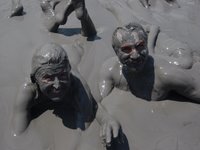
Dimitri and I went with a few people one day to the famous mud baths in the highlands outside the city. You ride to the rim of an inactive volcano cone that is full of water. On the edge of the lake there is a small hill that looks like a zit. Long ago mud would bubble to the surface so the locals turned it into a pool. As the mud overflowed they would shore-up the sides until it reach a height of about 30 meters. You climb up the staircase and lie in the warm mud. It’s so dense that you can’t sink. Actually, even standing up is possible with great dexterity. So you get completely covered and the local guys massage you. I don’t remember the last time I felt so, completely, relaxed and weightless. It is impossible to sink; it’s like swimming in warm chocolate custard. Then you waddle down to the lake, -not easy to do when the mud dries- where women will wash you off. They ask you to squat in the water and remove you swimsuit for them to wash. I wasn’t too sure if those pecker entering parasites existed there so I declined and washed it as best I could while wearing it.

On the return trip we stopped at a lovely beach side town and had lunch. The set menu wasn’t very appetizing but, cheap enough. After a few beers and a swim, to dislodge remaining mud, we returned to Cartagena and showered again. Man that stuff was persistent.

Dimitri went to Florida to get all the equipment in order to cross the pacific and when he returned we worked from morning to night getting ready. All final provisioning was done by mid November and then we were ready for the San blas islands. We had completed our upgrades and repairs, or so we thought. It is an old cruising boat after all. Sails had been repaired, the liferaft and it’s lovely new frame were installed, our EPIRB was mounted, the new cutter stay and running backs installed, starboard water tank repaired ( it broke again later) etc., etc. We also installed a new roller furler that was such a generous gift from Greg and Liz, we were touched. So off we went towards Panama and the canal.

Friday, April 27, 2007

Aruba to Cartagena


Sailing to Colombia offered a few nice stops along the way. However, should the weather turn ugly you could be stuck for a while. We were anxious to get to Cartagena get the boat ship shape for the Pacific and see the San Blas islands. The seas along the north eastern part of Colombia can get quite ugly at times. In particular, short and very steep seas. Fortunately for us the trip was mostly uneventful. We sailed 1/3 of it and motor sailed the rest in flat seas with no wind.

The only memorable event was off the coast of Rio Madelena. The wind was so light that a swarm of wasps managed to travel across the water and decided that our boat was the perfect place for a new home, there must have been 30-40. Dimitri was asleep and I sat in the companionway swatting them as they tried to enter the boat. I woke him up and said you deal with it, gave him a can of insect killer and then locked myself inside the boat to wait until he’d finished. I did feel sorry for him as I could hear lots of yelling and cursing but not enough to help. Protection is the man’s job, he put up a good fight and several wasps needed repeated clubbing. I made him a sandwich while I was down there though.

I was wrong about the events, two more. We were Boca Grande which has a submerged wall, waiting for daylight to enter the pass and didn’t see two fishing canoes and almost ran them over. They’re ok. Also as we got near Cartagena we could hear someone calling on the radio asking for a vessel to identify themselves. No idea it was us and when I went outside 10 feet away from us was a huge black coast guard boat. Boat was all black, 5 guys dressed all in black all carrying semi automatic weapons. Scared the shit out of me. We looked at each other for a minute or two and nobody said anything then I said ‘buenas dias’ they repeated it back, checked our papers and all was fine. They have to stop sneaking up on people.

When the sun came up there was enough light to see the unlit buoys and we passed through the channel, past the statue of the Madonna in the middle of the bay and up to Club Nautico. We anchored at 8am and an hour later a squall came in and a few of the boats in the anchorage dragged. In the end all was well. We decided to take a slip in the Marina for a couple of months. Dimitri was going to go to Sarasota and buy our equipment and it was too dangerous for me to stay on the boat by myself in the anchorage. The squalls were typical for that time of the year and re-anchoring on my own wasn’t an option.

Over the next 2 months we enjoyed Cartagena. The Marina was really nice and every morning there is free coffee to enjoy and incredibly cheap breakfasts. A glass of fresh squeezed juice, a plate of fruit and a plate of eggs, bacon and toast all for $2.00. How can you beat that, it costs more to buy it from the supermarket. Here we started to meet many English cruisers and became friends with some who we later

Aruba


Actually I didn’t sail to Aruba with Dimitri, Willem did. I didn’t feel like it and it gave me a chance to spend a few days with Lizzie doing girl things, lunches and gossip. It’s been such a long time. Willem wanted to go to get away from the bar and had had a stressful two weeks screening the world cup at the bar. They hired a huge movie screen for the event. The only way to watch it.

Willem and I set for Aruba and the wind was pumping and the swells running, so we decided to run on Genoa alone, stay close to the coast and head for an anchorage at Westpoint. With favourable currents we averaged 6.9 knots, anchored, swam to shore and partied. There were some local kids cliff jumping but we decided we were too old for these things. Too drunk more like it. That night we laughed so much that my cheeks were aching (facial). It was good to see Willem so relaxed. He even turned off his phone!


Next day the winds calmed but the swell was still running strong so we rolled our way to Aruba. Now we’re both very chatty guys who found ourselves completely mute until we tucked in behind the bottom of Aruba and the seas calmed. Both of us were green and just lay in the cockpit for the crossing. As soon as hit calmer water we began talking again like parakeets. It was late and we anchored near the airport after crossing a shallow bar. Got stuck in the morning, got off, tied up to the customs, got yelled at for not checking in the night before, got drunk waiting for immigration, sailed to the tourist beach, anchored, dinghied in, checked out the babes on the beach, back to the boat, ate Lizzie’s great stew, laughed our heads off, got drunk and passed out. A typical guy’s day out.

Aruba is quite a pretty island consumed by tourism. It reminded me of the east coast of Florida on a smaller scale with friendly people and the cleanliness/efficiency of Disneyworld. Two bus services covered the island and were reliable and cheap. We went into town often and explored the vast shopping areas, waterfront and craft outlets. One day on the bus back to our anchorage we noticed a happy hour sign outside a large hotel. It had just started so we jumped off and enjoyed cheap drinks by the pool. We met some very friendly people and an English girl promoting tourism to the UK. We had never seen the Union Jack displayed so prominently. The anchorage was off ‘high rise beach’ for all the tall hotel sprouting up everywhere. It was like being on vacation without the pricey hotel rooms. The beach was typical of any resort beach, clean, white, lots of waterspouts and bikini clad girls everywhere. What a great place. Only problem was the speed boats and wave runners kept circling the boat at high speed, like annoying mosquitoes. Watched some guys kite boarding, didn’t want to do it, just watching them while drinking a cold beer seemed like a better idea. Two old fat bastards on the beach not like the millionaire by the pool. I guess sometimes money does make a difference. Or maybe he has a great personality!!

A couple of days later and Willem returned to Curacao and Meri flew to Aruba. I offered to take Willem to town by dinghy. No problem in our new 10 foot dinghy and 15 hp Yamaha right. It wasn’t until we rounded the point, near the town, the wind picked up and the chop increased. We couldn’t run at speed due to the bone jarring pounding and the sea spray. Willem was giving me strange looks and was probably wondering how I’d survived at sea this long. I dropped him at a beach resort where he caught a bus while I pounded my way back and then went off to get Meri.
Over the next week, while waiting for a good weather window, we enjoyed the island and beaches and relaxed. Finally our window arrived and promised a safe sail to Cartagena, Colombia. I say safe because in the wrong conditions the eastern coast of Colombia can produce very nasty sailing conditions.

Curacao

The sail to Curacao was downwind and pretty straightforward. Finding the entrance to the anchorage (Spanish Waters) was another matter. The charts were telling us it was right in front of us as we stood off by 1/8 of a mile. It looked right, hills on both sides, a small opening etc. However, negotiating the pass didn’t look easy at all. Rocks to port, a beach to starboard and a slight dogleg as you enter. We decided to stay in deep water, close to the beach, avoid the rocky outcrops and, at worst, hit the sand should we miscalculate. The sun was high and we managed just fine. Once inside the pass it was deep and easy to navigate. After the formalities were finished we heard that ‘Sarifundy’s’ bar/restaurant was having a happy hour so of course we went. We got to reacquaint ourselves with boaters we’d met previously.

Upon arrival our old autopilot, refrigeration and several other parts decided to quit. I won’t bore you with details but it took some time and plenty of money to get it ship shape again. At this point we were going to sail back to Florida and sell the boat, try to settle permanently in Sarasota and pick up where we had left off. The hurricanes of 2004-2005 changed many things in Florida, insurance rates had skyrocketed and there was hardly any place left to leave our boat for a reasonable price. We didn’t know what to do, should we try to live on our boat in Marina outside of Sarasota, leave the boat with an agent and pay a fortune for a slip and commission and then rent an apartment. Should we try to sell it in Curacao? We couldn’t work out a solution.

In the meantime our repairs were progressing slowly and we were meeting some very nice people. A lot of them were going across the pacific to Australia and asked us why we didn’t do the same. The idea started to take hold, Adagio would be worth more in Australia and when we get there we would have a place to live while deciding where to live on land. Adelaide was no longer an option, not boater friendly with any safe anchorages. We still wanted to sail around, not with Adagio, but a smaller boat and Queensland seemed ideal.

After flying back to Australia for six months we realized that we missed our country and were tired of traveling. It had been 12 years already, that’s enough. We returned to Curacao with more enthusiasm and a decision had been made, at last. Meri asked me what we needed for the boat in order to do the Pacific. Other than a few repairs we mainly needed a new roller furler, a life raft and an epirb. I made a trip to the US, met up with our great friends and bought what we needed. Greg and Liz gave us the wonderful gift of a new roller furler. We were so touched by their generosity.

Apart from our repairs, it was our new Dutch friends and one lovely Scottish friend that encouraged us to stay a little longer. We had a wonderful time going out to restaurants, barbeques on the beach and one small concert with them that the time flew by. In the mornings we went walking with Bryan on SV Nightwinds and others on a nearby island. This island about 5 minutes by dinghy used to be a fuel storage area and has an abandoned building that used to hold slaves that were sick and needed to be quarantined. The roads are intact and the views of the ocean were awesome. Mike and Bryan are sailing a 65 foot Choy Lee sloop with plenty of deck space. They had a party there one night and 50 people could fit on the deck no problem. Those boys sure know how to party.

Sarifundy’s is the hub of the cruising fleet in Spanish Waters. Once a drive-in boat house it had been converted and extended out into the harbour on pontoons. Would make a very cool house in nice weather. Willem and Lizzie have decorated it in bright Caribbean colors and it’s such a cool place to sit and read, have a coffee or a beer and enjoy delicious food. Willem, Lizzie and Johnny were the owners and were so much fun. It took a while to get to know them on a personal level since they see so many boaters come through every year. Our friendship became closer after mainly Dimitri gave them a hand to repair the place (I helped a little). As cute as the place was it was in need of some major repairs as would happen to any place that’s on the water, salt water will do it every time. They closed the restaurant for 2 weeks and some their friends were there to start on the reconstruction. Marcello and Jack had experience with carpentry work but both Willem and Johnny knew they didn’t. Their strength was in business. They were very enthusiastic though. Dimitri went in and asked if they needed a hand and after letting them know that he had worked in construction most of his life accepted his help gratefully. They said they didn’t have enough money to pay him and he said he didn’t have anything else to do and would be glad to get off the boat for a while. He was given food and as much beer as he could drink so it cost them a small fortune after all. Ha. He started tearing down the walls to make a new opening into the kitchen. The more he tore down the more rot he found until one side of the bar was missing walls, roof and floor. The look on Lizzie’s face was priceless, kind of a mild shock. It said ‘oh no I’m going to have to sleep in the bar to stop the looting’ The side was wide open to the mangroves. He said ‘don’t worry, be happy, it will all be done by the end of the day’ but she didn’t look quite convinced. A production line got started with a very concerned Willem, Marcello and Phillip. They began to reinforce the floor, put new boards down, repaired the wall and seal it with plywood in time for a sundown beer. Great job guys.

Lizzie, Willem and Johnny were so grateful that Dimitri was getting very embarrassed. We fell in love with them. The whole job was completed in two weeks right on schedule, except for the elecrical work, but that's another story better told by Willem and Lizzy, and they were able to open again. From then on the friendship grew closer. Later on Willem and Lizzie took a well earned vacation, never seen people work so hard, and we house sat and took care of their dogs. So nice to have a house to live in for a while so it was a vacation for us also. Hope one day to return the favour in Australia.

For the cruisers Sarifundy’s was a gem. Happy hour twice a week, information sheet, free bus to the supermarket, free dinghy dock, free rubbish disposal, mail and package holding. That’s a lot of free services from people in a position to charge if they wanted to. Many places we’ve been to there is a charge. Panama for one, $5 a day to leave your dinghy. It should have been appreciated more but there are some cruisers who want everything for nothing and then demand more, like it’s their right instead of a privilege. It was embarrassing to listen to them. The irony was that the boaters needed them not the other way around. All their money came from the local people eating and drinking at the restaurant and almost nothing from the cheap cruisers. We’re so grateful to all the special people we met (too many to mention and difficult to spell). We especially would like to thank Ari for the mooning on our way out. It would have been better if Riad had flashed instead, she has a very impressive set and Dimitri would have enjoyed it more. What a Kodak moment.

Bonaire

Bonaire doesn’t allow anchoring in its waters for a couple of reasons. Firstly, the south side of the island only extends a couple hundred yards past the shore then drops rapidly. The bottom is quite hard so holding is questionable and should the wind reverse, as it often does, you’ll find yourself on the shore. Secondly, and most important, they are trying to protect the marine system. They provide moorings off the beach but it’s necessary to dive on the mooring, check the lines, chain and swivels yourself. They charge $5 a day; last I heard it had gone up to $10. We had heard about the fierce wind reversals and big swells that pound the couth coast at times. Of course it had to happen while we were there. The wind blew up to 30 knots and 2 meter swells started rolling in. We weren’t happy with the state of our mooring so decided to go into the marina that’s protected for a week. Lucky we did because the storm was so strong that one of the docks was completely smashed. The boats survived but the boaters went through a pretty scary night. Our friends Cedric and Jean-Pierre said they had to run the engine all night in gear and they had to stay on watch all night. Next morning lots of other boats had the same idea as us and we had a lot more company in the marina. Meri also got her fix of cable TV for a week so she was happy. The only downside was that the constant rain brought a swarm of mosquitoes and noseems and we had to be locked inside most of the time. At times like this it’s great to have air-conditioning.

When we were ready to leave we stopped at the fuel dock to fill up on diesel. Dimitri asks for the diesel nozzle and the very nice girl hands it to him and he proceeds to fill up. Some people we met on one of the islands were talking to us and then Dimitri noticed the smell of gasoline coming from our fuel filter and quickly told the girl to turn it off. She had accidentally given us the wrong nozzle and we had pumped 10 gallons of gas into the tank. I went into see the manager and told him what she had done and he reassured me that it wouldn’t cause any damage to our engine. What bullshit. I was livid and demanded that they empty out our tank and replace all the diesel. He refused and said it would be ok and they wouldn’t charge us for the gas. Wow, big consolation. When we said we would find an attorney to draw up a contract of responsibility if our engine was destroyed, he changed his mind. Living in the US has taught us a few things.

We went back to the moorings for a couple of days and Dimitri went diving right of the stern. Some of the best diving was right beneath us. The dive shop was across from us and it was an easy dinghy ride to the shop, fill up for a couple of dollars and do it again. He said it was spectacular, 100 foot deep wall of undamaged coral. I didn’t go in as I wasn’t feeling well I wasn’t into deep diving. That night it was Cedric’s 40th birthday and we had a little party. They had caught a big, delicious fish and they barbequed it and then we got shit-faced. Well, we went home fairly early but the boys continued to party all night until the wee hours and still managed to look refreshed after a couple of hours sleep. I don’t know how they do it. The town of Bonaire is very cute; all set up for tourism with bars and restaurants everywhere. On the weekends it was hard to sleep with all the loud music coming over the water. We decided it wasn’t really our thing so we set off for Curacao.

Venezuela to Bonaire

Watch this space for more info.